
When the Road Keeps Failing, Try Thinking Inside the Tire
As part of USTMA’s Full Circle platform and America 250 Second Life Stories initiative, these stories highlight the people helping build sustainable end-use markets for recycled tires while solving real infrastructure challenges in their communities

CALIFORNIA
Champions and challenges are raising awareness of the proven engineering, economic and environmental value of tire derived materials and have opened the door for engineers and highway departments to confidently use and rely on these materials to fix the nation’s infrastructure.
Mendocino County had a significant road challenge: Marina Drive had slid three times in the last decade. Records showed resurfacing attempts dating back to 1965, but every time the county fixed it, the road moved. At one point, more than 30 inches of asphalt had been applied to the road, but the problem kept getting worse. The weight of the roadway was its own worst enemy.
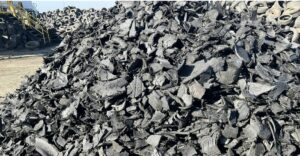
Joaquin Wright, the current Technical Director of GHD Environmental was called in to help find a permanent fix. His fix came from an unexpected place: tires. By filling the failed embankment with shredded end-of-life tires in lieu of rock or soil, the problem could be solved for good.
The logic was elegant. “The weight is the driving force behind a road slide,” Wright explained. TDA weighs half to one-third of the weight of conventional fill and it doesn’t hold moisture or shift the way clay-heavy soils do. Used properly, the shredded tires broke the cycle that had defeated every conventional repair for six decades. The Marina Drive project – California’s first TDA landslide repair – used 165,000 recycled tires and has held steady since 2007.
“California generates 51 million waste tires a year. That’s not a waste problem. That’s a supply chain waiting to be organized, Wright believes.
Joaquin Wright has been working with TDA since 2000, when the applications were still experimental, and the engineering community was highly skeptical. He came up through Humboldt State University with a degree in Environmental Resource Engineering, credentialed as a Sustainability Professional through the Institute for Sustainable Infrastructure, and joined what eventually became GHD, one of the country’s leading environmental and civil engineering firms.
His partnership with CalRecycle – California’s Department of Resources Recycling and Recovery – has grown into one of the most productive TDA research and deployment programs in the United States. GHD holds the state’s engineering and construction management services contract for civil engineering applications using TDA. In practical terms, that means when California wants to figure out if TDA can solve an engineering problem, Joaquin Wright’s team is at the table.
The portfolio of California TDA projects that has grown over those years is remarkable in its variety: road embankment slide repairs across the state’s challenging coastal terrain, stormwater infiltration galleries in urbanizing communities, retaining wall backfill for structures where reducing lateral earth pressure is critical, and one of TDA’s most visible California applications, vibration mitigation for light rail.
The Bay Area Rapid Transit Warm Springs Rail Extension used TDA to reduce train vibration and associated noise impacts in adjacent communities. It performs as well as floating concrete slabs, at a significantly lower cost.
Joaquin speaks quite directly about the role of research in making TDA adoption possible at scale, stating that engineers don’t specify materials they can’t defend. Every CalRecycle publication, every peer-reviewed paper on TDA shear strength and compressibility, every ASTM standard, gives civil engineers confidence to write TDA into a project specification and stand behind it.
 Joaquin has been a co-author on multiple technical publications defining TDA material properties and he’s trained engineers across the country. He’s also presented at ASCE chapter meetings, state DOT conferences, and tire recycling industry gatherings – anywhere the gap between the research and the practical application needs to be closed. In his experience, that gap is almost always about awareness and confidence, not capability.
“This program wouldn’t be doing what it’s doing if there was a concern about environmental safety. The science is solid. What we need now is more engineers who know about it.” Wright said.
California’s size makes it uniquely important in the TDA story. With 51 million used tires generated annually (the most of any state), California has both the greatest supply of raw material and some of the most complex engineering challenges. These include seismically active terrain, aging infrastructure, severe drought conditions followed by flooding, and rapidly developing communities that need stormwater management solutions that work in constrained spaces. TDA addresses all of these.
What Joaquin Wright has helped build in California over 25 years amounts to a proof-of-concept library that engineers across the country can draw on. Each project is a story of a slide repair that held, a stormwater gallery that performed, a light rail that runs quietly through a neighborhood, all because of tire-derived aggregate.
“The next generation of TDA engineers won’t have to start from scratch. They’ll build on a foundation set by Joaquin’s work, and the work of many others”…CalRecycle.
© Scrap Tire News, September 2026
SPONSORS