
The Importance of Standardized Testing For rCB
From feedstock to pelletizing, better control and standardized testing are unlocking the performance and environmental potential of recovered carbon black
Two recent open-access studies highlight why high-quality rCB now depends as much on process control and post-processing as it does on the pyrolysis step itself. One study published in Polymers by Norris et al. (2025), used a Mars Mineral Pin Mixer to pelletize rCB before in-rubber testing. The pellets reached a consistent hardness below 80 gram force (gf), demonstrating how reliable agglomeration demonstrates how equipment enables laboratory findings to translate directly into commercial practice.

As rCB grows into an industrial material, ASTM standards are helping the industry speak a common language. Several methods now play a central role in characterizing rCB quality: ASTM D5230-21 for pellet hardness; ASTM D6556 for surface area ASTM D8474-23, a new method specific to rCB, for determining composition and volatile matter; ASTM D1506-23 for ash content; ASTM D1618 for toluene discoloration
Looking ahead, ASTM C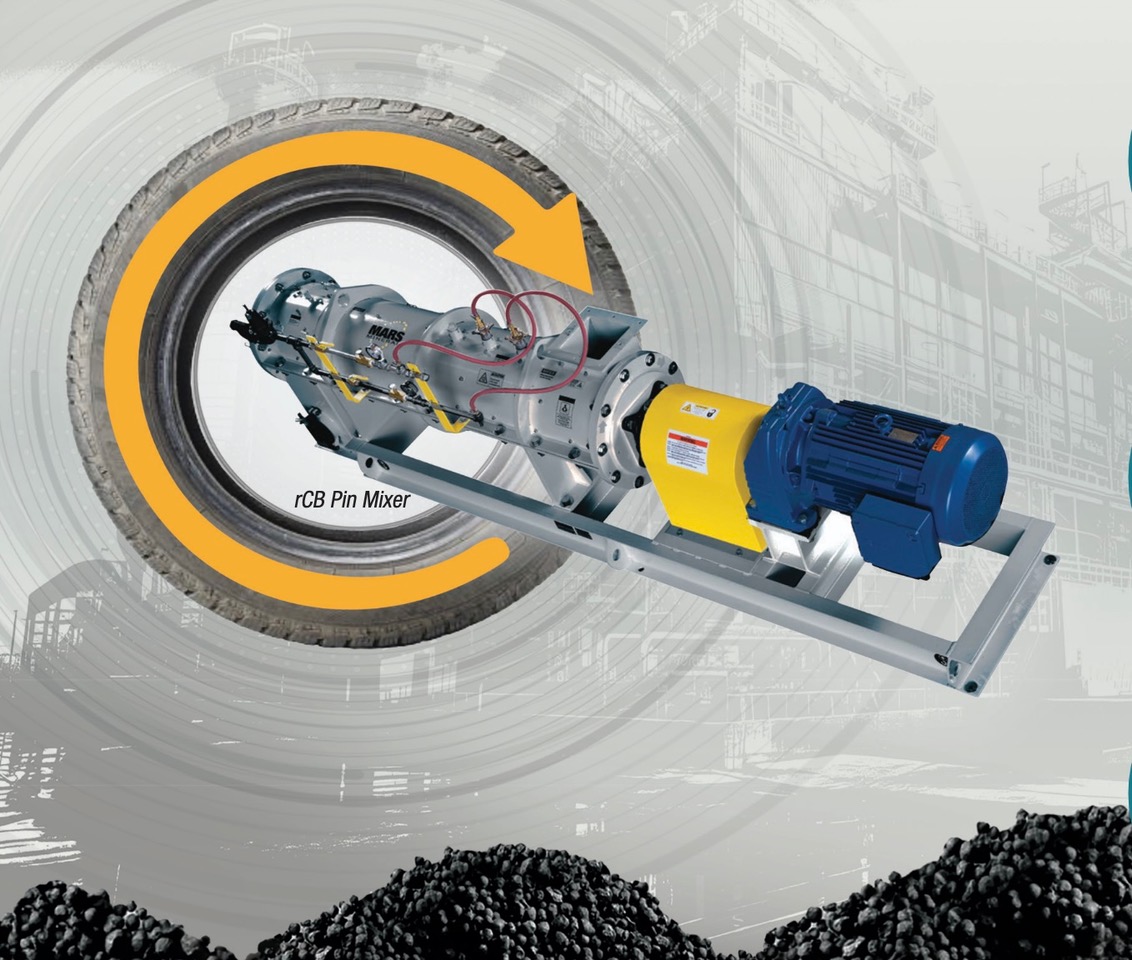 ommittee D36 continues to expand the testing and classification framework for recovered carbon black. As the industry begins to standardize material definitions, producers with strong process control and verifiable data will set the pace. Pelletizing and pellet testing provide the proof points needed to support those claims
Pellet quality has a direct impact on how rCB behaves in production environments, such as rubber manufacturing. Uniform, dense pellets flow cleanly, generate less dust, and disperse predictably during compounding. High-intensity pin mixing, with controlled water
addition, creates that repeatability and gives rCB the strength to handle storage, transport, and mixing without the risk of uncontrolled breakage.
Pelletizing cannot fix poor feedstock or uncontrolled pyrolysis conditions, but it plays a crucial role once the chemistry is right. A stable pelletizing process helps preserve the quality achieved upstream., enabling rCB to perform consistently in downstream operations.
The same relationship between feedstock quality and downstream behavior is reflected in recent studies. Most rCB samples Mars tested contained less than four percent carbonaceous residue and pelletized well using water alone as the binder. Higher residue levels required surfactants to wet the powder. That is a practical indicator of surface production.
© Scrap Tire News, March 2026
SPONSORS