
Overcoming Road Paving Challenges With Rubber Modified Asphalt
Sometimes, when a road fails or is facing failure, challenges can quickly mount beyond traditional paving solutions throwing it into an emergency situation. This is especially critical on heavily trafficked, major thoroughfares.
That was the situation the City of Fort Collins, Colorado faced three years ago when significant load-related distress was appearing in the surface course of the travel paths on South Timberline Road, a vital north-south arterial road that runs all the way through the eastern side of the city and handles immense volumes of commuter and commercial traffic daily.

The road was scheduled for a heavy overlay in 2024, but this was postponed due to capital project widening further north. For Fort Collins’ street maintenance engineers, it became clear that this road would not last the winter without major pavement failures.
In December 2024, emergency patching was done to get this surface through the winter. This patching effort assessed the sub-overlay pavements and bases and discovered that the asphalt had completely failed, but the base was sound and competent.
With this challenge identified, and the concern for cost of a complete reconstruction, Street Maintenance Program (SMP) Engineers explored alternatives to save cost.
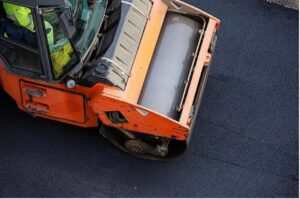 Another challenge to the project was the need for full closure to allow safe, effective, and quick construction of the overlay with many other competing right-of-way projects. City traffic officials would only allow this closure if it could be done in March or early April to not overlap with other closures.
At this time of year in Colorado, paving with highly modified asphalt binders is very difficult because compaction of the mat is hampered by cold temperatures providing less than a half-hour to achieve compaction prior to the mix dropping below 190 degrees.
In early April of 2025,a demonstration, dry process rubber-modified pavement was placed on South Timberline Road in Fort Collins, CO. The dense-graded surface mix was modified with Elastiko Engineered Crumb Rubber (ECR) manufactured by Asphalt Plus LLC.
The project sponsor was The City of Fort Collins Public Works Department and the contractor was Martin Marietta Materials.
The Elastiko ECR product is a minus 30 mesh ground scrap tire crumb rubber product that has been chemically engineered to optimize the behavior of rubber in asphalt pavements. The rubber crumb is treated with a bonded chemical coating that supports steady and accurate feeding from loss-in-weight feeding systems.
The ECR coating system is designed to support uniform, accelerated interactions between the rubber crumb and the binder during mix production. The coating is also engineered to reduce/eliminate the stickiness and plant buildup common in rubber-modified mix designs.
The ECR product is transportable in both bags and bulk carriers, and the dry material is designed to flow consistently in all temperatures. ECR is currently fed from both fiber feeders and loss-in-weight silos. For the South Timberline Road project, the product was shipped to the location in water-resistant bulk bags on tarped trucks.
The new dry mix ECR process proved to allow a neat, standard binder (PG 58-28) to be modified to a PG 70-28 without the complications of polymer impacts to compaction temperatures. The ECR mix allows compaction of the 3 and 2-inch lifts down to 150 degrees Fahrenheit with a warm mix additive. This solution proved perfect as there was snow literally the day before the project started, SMP engineers said.
This was a night paving project on a closed arterial. The project paved approximately 1.5 miles of a two-lane road, plus some additional bike lanes, using mill-and-overlay asphalt surfacing.
With the closure, the project was completed along the mile corridor, placing 4,500 tons of ECR modified asphalt in five days and recycling approximately four thousand tires while improving the asphalt performance and reducing cost of reconstruction.
The South Timberline overlay project was innovative in that City staff working with Martin Marietta was able to find a cost-effective way to resurface an existing failing road surface, convert the pavement to a perpetual surface and limit the impact on the traveling public while providing crews a safe and effective work zone.
The construction that took only five days used a new dry mix technique to blend recycled ground tire rubber into the asphalt binder with only minor modification to the asphalt plant.
These modifications allowed a standard neat binder to be used with the ECR bumping the grade without changing the compaction constraints, thus allowing this early season paving which would not have been possible with the cold temperatures of spring in Colorado.
The primary criteria for success of this project was to rehabilitate South Timberline without the expensive and time consuming need to reconstruct the pavement section. The secondary criteria was to craft a pavement overlay that could be constructed with standard equipment in the cold months of spring in Colorado and create a pavement that would be perpetual, not requiring any significant reconstruction in the future.
The South Timberline overlay was piloted by the City of Fort Collins to prove that the dry mix method to incorporate ECR into the binder could be done with standard available fiber blowing equipment to introduce the recycled tire rubber to the rap collar of the asphalt heating drum without significant difficulty.
The South Timberline overlay project came together through the combined efforts of city SMP staff, asphalt mix design to incorporate the ECR to Martin Marietta mixes by Asphalt Testing Services of Loveland and warm-mix additive guidance from Western Infrastructure.
The guidance for using ECR to modify available asphalt binders was from Asphalt Plus LLC, and Punya Rath of Missouri University.
“This was a multi-party effort led by the City of Fort Collins Streets Maintenance Program to pilot and demonstrate the feasibility and cost effectiveness of using recycled tire rubber in a dry-mix, ECR asphalt overlay, “Asphalt Plus president Red Clark said. “With proper sample management in the lab, the selected dense-graded mix design modified with ECR was able to meet both performance and production requirements for the City of Fort Collins and Martin Marietta Materials.
For Fort Collins city engineer Tom Knotsman the project met the city’s goal to find alternatives to modify standard neat asphalts and produce an effective, strong binder that would be crack-resistant and strong enough to meet perpetual pavement design.
The Fort Collins South Timberline field demonstration proved the theory for cold season paving and was shared widely with state and local engineers.
© Scrap Tire News, October 2026
SPONSORS