
Ann Arbor Paves First Roads With Rubberized Asphalt

Working with Michigan Technological University (MTU), the city laid rubberized asphalt in two street applications as part of its ongoing commitment to infrastructure improvement and sustainability.
In total, approximately 9,300 tons of asphalt mixtures will be placed, including about 3,730 tons of rubberized asphalt mixture, which is equivalent to recycling approximately 2,000 passenger tires.
The City used a special asphalt mix using Elastiko engineered crumb rubber (ECR) additive derived from recycled tires that has the potential to extend asphalt life, significantly lower greenhouse gas emissions, and improve the user experience on Ann Arbor roads.
Elastiko ECR, a product of Illinois-based Asphalt Plus functions as a modifier interacting with binder and aggregate to improve overall mixture performance. It enhances flexibility and durability and prevents cracking and rutting, Asphalt Plus President Red Clark said.
The rubber acts to stop a crack in its place or send it in a different direction, potentially extending pavement life 30-40 percent more, Clark said.
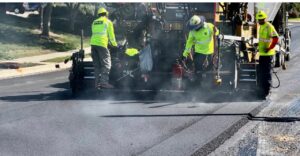 For the City, collaborating with MTU demonstrates how it can continually improve infrastructure and advance sustainability goals. “We have the opportunity to capture real world information about how rubberized asphalt works in practice and work towards a more circular economy by keeping tires out of the landfills,” Nick Hutchinson, City of Ann Arbor Engineer, said.
Funding for the project is provided in part from a grant secured through the Michigan Department of Environment, Great Lakes, and Energy (EGLE) via their Scrap Tire Market Development Program.
Additional rubberized asphalt construction is anticipated in the city next year to further fulfill the project contract and expand the use of sustainable pavement technologies. As part of the project, the team will compare the performance of rubberized asphalt resurfacing with that of conventional asphalt.
Modified rubberized asphalt produces streets with smoother pavement, less road noise, and better wet weather traction. Smoother roads also mean improved vehicle fuel economy and reduced generation of tire microplastics.
Modification of asphalt pavements with tire rubber will extend road life, typically by 30 percent or more. This means substantial savings in future road maintenance costs and reduced future construction events.
When it is time to remove and replace those asphalt pavements, the rubber in the asphalt can be reused in the new pavement, further increasing the circularity of the tire rubber in the asphalt mix.
Ann Arbor residents generate more than 70,000 scrap tires each year. “If we incorporate some of those tires in our roads, we improve both our infrastructure and our environmental quality,” Hutchinson said.
The City of Ann Arbor was the lead during project implementation, including coordination with contractors and stakeholders, assistance with data collection at asphalt plants and construction sites, and facilitation of effective communication throughout the project. “
Dr. Zhanping You, the Principal Investigator from Michigan Technological University believes this project provides a strong example of how recycled tire rubber can be effectively used in municipal road construction to improve durability and sustainability at the same time. It’s also an opportunity to demonstrably improve the user experience while also making significant strides towards reducing greenhouse gas emissions associated with street surfacing, Dr. You said.
You and his team are also working with the County Road Association of Michigan, the Michigan Department of Transportation and the Federal Highway Administration to develop guidelines to help road engineers widely adopt the use of recycled rubber in road construction.
“We are starting to draft guidelines for the state of Michigan,” said You. “The goal is to have a draft of specifications ready by next year. Hopefully then, people will be more willing to try it.,” he said.
Asphalt Plus obtained recycled tire rubber from the region and coordinated efforts with pavement contractor Cadillac Asphalt to convert the material to Elastiko engineered crumb rubber to be added to the asphalt mix at the plant
Rubberized asphalt is placed on roads the same way as standard asphalt and does not require any special equipment during placement.
Rubber from more than 7,000 scrap tires was mixed into asphalt in another Ann Arbor-area road project in Washtenaw County last year. It was considered a first for the Washtenaw County Road Commission.
“We have pavement’s down in the UP and we’ve had them down in the state for 15 years. They’re behaving well in cold climates and heavy trafficked roads,” Clark said.
While typical asphalt pavement under the right conditions might last up to 40 years, the science suggests this type of pavement with rubber in it could last up to 60 years, Clark said.
© Scrap Tire News, July 2026
SPONSORS