
Compton Installs Rubber Medians to Deter Street Takeovers
City officials placed rubber medians in some of their most notorious hotspots for street takeovers to hinder future sideshows
Following a surge in illegal street takeovers across Southern California—including an incident this summer in South Los Angeles that escalated into the looting of a grocery store—the city of Compton has launched a new physical strategy to reclaim its intersections.

Instead of relying solely on a law enforcement response, city officials are installing physical barricades directly onto the asphalt. The new low-tech solution features heavy-duty recycled rubber medians placed in the center of notorious takeover hotspots, physically preventing vehicles from drifting or spinning in circles.
The initiative is part of what city officials are calling an aggressive “elimination campaign” targeting erratic driving.. “We are on an elimination campaign,” city spokesperson Marcus Harris said. “We want to stop all the street takeovers in the city of Compton.”
The city installed Street Defender Curbs manufactured by New York-based RubberForm Recycled Products.
“These are rubber medians, and these are for deterrence for the street takeovers,” Marcus Harris with the City of Compton said in a CBS LA broadcast.
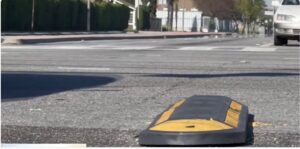 Harris detailed that the initial rollout targeted three major problem spots: “Alandra and Central, Long Beach and Compton Boulevard, then a third street was Wilmington and Stockwell”.
The rubber medians act as a physical barrier in the middle of the intersection, severely limiting the open space required to perform donuts without a driver risking structural damage to their own vehicle.
The city opted for rubber over concrete because modular rubber traffic barriers provide a durable, cost-effective alternative to traditional concrete or asphalt infrastructure. “It is a fast and budget-friendly installation,” City of Compton engineer Jack Gong said.
“This rubber medium will last at least 10 years,” Gong said, confirming the durability of the barriers.
Manufactured from 100 percent recycled composite materials, the modular curbs are engineered to last at least 10 years and withstand high-velocity impacts while costing a fraction of poured concrete medians.
The data suggests the physical deterrents are working. According to the Los Angeles County Sheriff’s Department, Compton and its unincorporated areas have seen a “45 percent decrease in the first and second quarters of 2026 compared to the same time last year” following the installation of the medians.
At the intersection of Wilmington and Alondra, where the medians were installed in February, there are currently no visible fresh tire marks from street takeovers.
Meanwhile, unequipped intersections just half a mile away continue to bear the scars of heavy drifting, indicating that while the takeovers may be shifting to unprotected streets, the rubber medians are successfully defending their installed locations.
For local residents, the infrastructure change has provided immediate relief.
Longtime Compton resident Willie Breaux expressed his support for the project saying the rubber medians have been a game-changer in his neighborhood. “I haven’t seen one takeover which helps the city with the fire department, police department to get through to help somebody in need”.
With the early success of the initial test sites, the city is preparing to expand the program aggressively. “We’re looking forward to installing another 30 intersections to deter them from doing any type of erratic driving,” Harris said.
Recent external reports indicate that Compton’s physical road redesign is being treated as one layer of a broader strategy, working alongside new state and county legislation that authorizes stricter fines, 90-day license suspensions, and vehicle impoundments for sideshow participants.
© Scrap Tire News, October 2026
SPONSORS