How Modern Containment Measures Reduce Microplastic Emissions from Synthetic Turf Fields
Microplastics have emerged as an important environmental conversation. Synthetic turf fields, which use recycled rubber crumb infill, have become part of that conversation, and the concerns raised deserve to be taken seriously.
The amount of infill material that leaves a typical synthetic turf field has historically been small. Most of what leaves is carried away in players’ shoes or clothing, where it ends up in changing rooms and residential waste streams rather than in the natural environment.

New technology has been demonstrated and verified in the United States and Europe that dramatically reduces microplastics from infill from ever leaving the field. Even compared to the new EU REACH standards of 50kg (110 pounds) or less microplastic from fields, these results represent an 80 percent reduction.
The technology installed at fields in Cardigan Mountain, New Hampshire and Silkeborg, Denmark, demonstrated how to implement risk management measures such as gates, grates, fences, and designated entrance and exit areas, as well as measure the dispersion of microplastics from infill.
These fields were subjected to rigorous testing over the course of two years, conducted by Firefly Sports Testing and the Danish Technological Institute. Researchers measured multiple potential pathways for infill migration, including over field perimeters, through players, by maintenance equipment, and via water drainage.
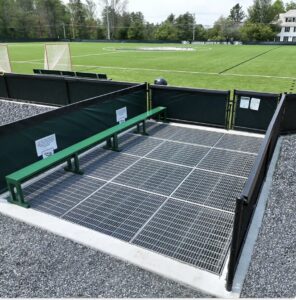 The results found that perimeter barriers around the field — including entrance and exit gates for players (with mesh grates and brushes to clean shoes), maintenance equipment grates, and drainage management — significantly reduced infill migration to as little as 10 kilograms (22 pounds) per field per year. That represents a 98 percent reduction compared to original European Union estimates of microplastics from synthetic turf fields.
Barrier height proved critical to effectiveness. For example, 60-centimeter (2 feet) barriers achieved substantially greater reduction than lower barriers, particularly in summer conditions. In fact, when these technologies are put into place, most infill leaves the field via players’ shoes and is stuck to clothing, where it is normally disposed of in residential garbage and is unlikely to enter the natural environment.
The effectiveness of these technologies has gained international recognition. In a significant policy decision, the United Kingdom recently chose not to ban recycled rubber infill, instead opting for containment measures that can reduce microplastic emissions by more than 90 percent.
See the full report at: www.recycledrubbercoalition.
© Scrap Tire News, October 2026
SPONSORS