
Continental Uses Vacuum Technology To Study Tire Wear Particles
Continental has partnered with the Technical University (TU) of Braunschweig to develop an innovative method for analyzing tire wear. This method uses a specially adapted vacuum device mounted behind a drive wheel, which, together with advanced particle sensors, collected particles as they were emitted, allowing researchers to determine the origin of even the finest airborne particles – whether they came from the tires, road surface or brakes.
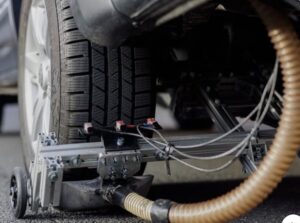 Particle measurement instruments developed by TU Braunschweig were mounted at various points on the vehicle, including directly behind the wheels, to collect detailed, time-specific data. These measurements were correlated with factors such as driving dynamics, road surface conditions and weather – an essential step toward scientifically accurate tire wear analysis. Using a newly developed multi-sampler device, researchers were able to collect samples related to specific driving events. In the lab, they compared particles gathered during cornering versus straight-line driving.

This measurement technique was developed as part of the recently completed research project OLRAP (“Online Analysis of Airborne Tire Wear Particles at the Point of Origin and Differentiation from Other Sources”). The insights gained feed directly into Continental’s tire development, enabling targeted improvements and preparing the tiremaker’s products for upcoming regulations like the Euro 7 standard, which will introduce limits on tire wear emissions in the EU starting in 2028.”
“The highly complex experimental setup, with simultaneous measurements at different points on our test vehicle, generated vast amounts of data, helping us to better understand tire wear,” says Dr. Benjamin Oelze, head of Tire Wear Testing Development at Continental Tires. “We identified clear correlations between particle concentration and speed profiles, as well as the impact of high longitudinal and lateral acceleration on tire wear.” These findings could help optimize traffic flow and vehicle driving profiles to reduce emissions and improve environmental sustainability.
Continental has long been committed to research projects focused on tire wear, without compromising on safety or performance The tire manufacturer co-chairs the Tire Industry Project (TIP), an initiative that studies the environmental impact of tires throughout their life cycle. Continental was also the only tire manufacturer to take part in the RAU project (“Tire Wear in the Environment”), an initiative by the German Federal Ministry of Research. This project developed a filtration system capable of capturing up to 97 percent of solid particles beneath storm drains.
© Scrap Tire News, December 2025
SPONSORS