Recycled Tires Offer Flood Fix
After years of persistent flooding problems, the Grady County Road Department has raised Lower Cairo Road by 12 inches using a foundation built from 3,300 recycled scrap tire cylinders

Mechanical Concrete technology from Century Road Solutions, is engineered to confine and reinforce aggregate using interconnected tire-derived cylinders. The system creates a mechanically stabilized layer that significantly increases load-bearing capacity, reduces displacement, and strengthens weak subgrade conditions—ultimately improving road durability and extending overall service life.
Typically, stone aggregate is used as ballast in the cylinders. In an interesting twist, aggregate made from recycled asphalt pavement (RAP) was used to fill the cylinders for the Grady County job.
George Walker with Century Road Solutions said the project began when Julie Shutters, Implementation Manager of the Golden Triangle Resource Conservation and Development Council, attended a presentation in Meriwether County.
“She was one of the most engaged attendees at the demonstration in Meriwether,” Walker recalled. “She took the information back to the Golden Triangle and proposed it.”
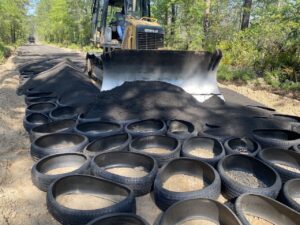 Through the collaborative efforts of Shutters and Grady County, Century Road Solutions was able to rehabilitate approximately 1,000 linear feet of roadway, construct roadside ditches, and replace culvert pipes to better manage drainage and reduce flooding issues, along with strengthening the weak and stable sections of the road base through the installation of approximately 3,300 tire-derived cylinders.
“Grady County had a problem where the dirt road would wash out when they only got 3 inches of rain or so, and the Road Department would have to come back and repair it so others could use the road,” said Douglas Carlson, VP of Asphalt Products for Liberty Tire Recycling. “These roads serve as school bus routes, emergency routes for inclement weather, or emergency treatment for emergency response vehicles. Dirt roads are a lifeline to the community.”
Seeing that, Grady County found it important to keep the road in service and relied on Mechanical Concrete to do the job.
Century Road Solutions Mike Getz said this could not have been done without Liberty Jackson supplying the cylinders and logistics. “Liberty’s crew and driver did exactly what they committed to do. Delivered a perfect load, showed up on time and driver and crew worked together to complete the job.
“It’s been rewarding to be a part of the project,” Carlson said.
“Georgia has a lot of counties that are rural with dirt roads that have the same soil conditions as Grady County, and it’s ripe for opportunity,” Walker said.
While Lower Cairo was considered a smaller job, Walker said they have completed jobs using up to 14,000 scrap tires. By using the scrap tires, the county saves roughly 35 percent on equipment use, aggregate volume, and routine maintenance in the future, he said.
“You’re using less aggregate to support the same load,” he explained. “By adding the tire structure in there, you’re able to support the same wheel load as 18 inches of gravel, but you’re only using nine. You’re saving 50 percent on your aggregate volume.”
Also, the Mechanical Concrete technology does not require multiple passes by high-skilled motor-grader operators or other equipment operators, reducing labor costs.
The County will also save money by not having to grade the road as often. “You won’t have the same washing and potholing in Mechanical Concrete because of the way the aggregate behaves,” he said. “That has a cost savings that can exceed 35% into the future as the lifespan of the road is extended.”
Beyond the cost-saving measures for Grady County, Walker wanted to ensure that the road construction, roadside ditches, and culvert pipes did not have any impact on the wildlife in the area. Throughout the duration of the project, the Department of Natural Resources was on-site.
“Their presence meant a lot,” Walker said. “They manage wildlife areas across the state and work with Georgia DOT, and those different access points exist, so it was very important for us to have them there.”
The clean water benefits brought about by Mechanical Concrete will be assessed by Shutters and her team. The data will then be provided to Walker and his co-workers for future projects in rural areas.
The hope is that the project will be beneficial enough to members of the Grady County and provide enough data for the team to continue working alongside the Grady County Roads Department, Shutters, and local officials to help improve other dirt roads in the community suffering similar foundational issues.
Source: Jill Holloway timesenterprise.com
© Scrap Tire News, July 2026
SPONSORS